Make Better Poker Bluffing Decisions With One Simple Test
Calculate a bluff’s break-even fold rate, name the better hands that may fold, and use position and price to choose the disciplined action.
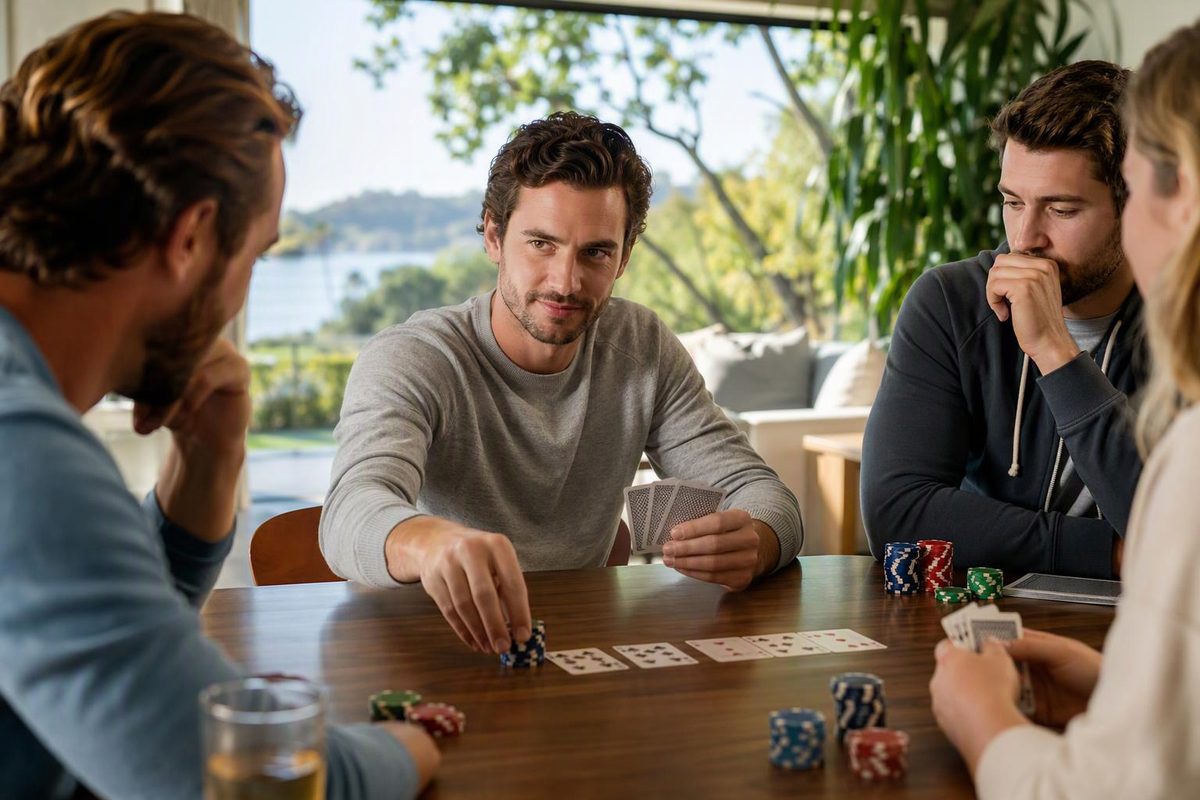
A bluff is a bet or raise made with a hand you do not expect to be best, intending to make a better hand fold. Checking a weak hand is not a bluff, and calling cannot be a bluff because a call gives the opponent no chance to fold. For a beginner, bluff only when you can name the better hands that may fold and the price makes sense. PokerNews uses the same basic definition.
Enter the pot and proposed bet; add your fold estimate to test the bluff’s expected value.
Bluff Break-Even Check
The fold threshold assumes a one-street pure bluff that always loses when called.
Result
A 40% fold estimate is above break-even by 6.7 percentage points.
Break-even fold rate = bet ÷ (pot + bet). EV = (fold rate × pot) − (call rate × bet).
Source note: Formula described by GTO Wizard; bluff definition follows PokerNews. Defaults use the article’s $100 pot, $50 bet and 40% fold estimate.
Use the same order for each bluffing decision: hand, position, price and action.
The Hand Determines What Kind of Bluff You Have
There are two useful categories:
- Pure bluff: You cannot—or are extremely unlikely to—win if called. A missed draw on the river is the usual example.
- Semi-bluff: You may be behind now, but you can improve if called. A flop bet with a flush draw can win through either an immediate fold or a later flush.
A semi-bluff has a second way to win. A random weak hand with no draw does not. The simple break-even formula used here applies to a pure bluff with no chance of winning when called.
Before betting, name the target. “I want a small pair to fold” is a testable idea. “I want to look strong” is not. If the opponent’s likely range consists mostly of strong hands that will call, the bluff has no useful target.
Showdown value also matters. A hand that can sometimes win after checking may be a poor bluff candidate if betting folds worse hands and gets called by better ones.
Position Reduces Uncertainty but Does Not Create Folds
Bluffing is simpler when you act last. If an opponent checks, you have seen their action before deciding whether to bet. Position does not make a poor bluff good, but it gives you more information before chips go into the pot.
Prefer heads-up pots while learning. With several opponents, every remaining player must fold for a pure bluff to succeed. The more players who can continue, the less often everyone will fold.
This begins before the flop. Entering too many pots creates more marginal postflop decisions and more temptation to force a bluff. A disciplined starting range remains the foundation; see preflop hand selection for your first 1,000 hands.
The Price Sets the Required Fold Rate
For a first bet with a one-street pure bluff, the break-even fold rate is bet ÷ (pot + bet).
The formula compares what you risk with what you can win immediately. It assumes:
- your hand loses whenever called;
- the opponent either calls or folds, without raising;
- there is no later betting street;
- the stated pot is the amount available to win, with no additional fee deducted.
A $50 Bluff Into a $100 Pot Needs 33.3% Folds
Assume a low-stakes cash game. The river pot is $100, you are heads-up and in position, and your opponent checks. Your missed draw has no realistic showdown value.
You consider betting $50. The break-even fold rate is $50 ÷ ($100 + $50), or $50 ÷ $150, which equals 33.3%.
The opponent must fold more than one time in three for the pure bluff to have positive expected value under these assumptions.
Suppose your best range estimate says the opponent folds 40% and calls 60%. Expected value is calculated as (fold rate × pot won) − (call rate × bet lost).
For this example, EV is (0.40 × $100) − (0.60 × $50), or $40 − $30, which equals +$10.
That does not mean the bet wins $10 this time. It means its average value is $10 if those assumptions remain accurate over many comparable decisions.
GTO Wizard gives the same risk ÷ (risk + reward) threshold and stresses that it describes a 0%-equity bluff. Before the river, a hand often retains some equity, and future decisions make the calculation more complicated.
Bigger Bets Must Work More Often
Bet size changes the threshold:
| Bet into a $100 pot | Break-even folds needed |
|---|---|
| $25 | 25 ÷ 125 = 20% |
| $50 | 50 ÷ 150 = 33.3% |
| $100 | 100 ÷ 200 = 50% |
A larger bet may cause more folds, but it also has to work more often. “Bet big so they have to fold” is incomplete reasoning. You still need a credible estimate that enough better hands will fold at that size.
The Final Choice Is Bluff, Check or Give Up
Consider bluffing when your hand has little showdown value, you can identify better hands that may fold, and the required fold rate appears realistic for this opponent. Heads-up pots and position make that judgment easier. Your earlier actions should also be consistent with value hands betting this way.
Check or fold when you cannot name a better hand that folds. The same applies when several players remain or the opponent has repeatedly called large bets with modest hands.
Checking is often preferable when your hand has enough showdown value that betting mainly folds worse hands and gets called by better ones. Continuing only because you bluffed an earlier street is not a reason to bet again.
Money already placed in the pot is gone from the current decision. It does not justify investing more. Multi-street bluffs can become expensive because each called bet grows both the pot and the next amount at risk.
In a deliberately simplified pot-sized triple-barrel example, GTO Wizard shows why evaluating only the final river bet can hide losses from earlier streets. The exact threshold depends on every street’s bet size and fold rate.
A One-Street Test Keeps the Decision Disciplined
Start with one-street decisions. Before placing chips, complete this sentence:
“I am risking ___ to win ___, so this bluff must work ___% of the time, and I expect these better hands to fold.”
If you cannot fill in all four blanks, check or fold. Folding is not a failed bluff. It is the correct choice when the target or price is unclear.